
Technical capability

Operational applications and CRM

Internal systems that replace fragmented processes with auditable workflows. Built for intensive daily use, with granular RBAC, audit logs and integrations into existing systems, ERP, accounting, SSO.

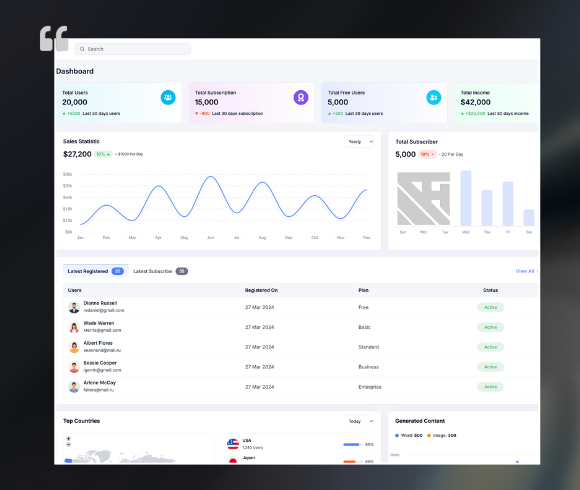
ERP / CRM dashboard
Specimen 01ERP / CRM dashboard
Typology
Internal operational system
Engagement
End-to-end, architecture → production
Format
Dedicated team with a single coordinator
Horizon
8–16 weeks · working MVP

Who this capability is for.

Companies with operational processes fragmented across Excel, email and legacy systems. Teams that handle large daily volumes of transactions, orders or cases and need full traceability, an audit trail and granular access per role. Typically: custom ERPs, fleet-management systems, resource planning, B2B CRMs with specific business logic.

How we work, in practice.

We start by mapping the existing processes and the points of failure. We model the data domain and the access matrices before any line of code. We implement in short iterations with a mandatory pass through staging, strictly typed code, an audit trail built in from the start. We integrate directly with existing systems, accounting, SSO, third-party ERPs, through APIs or dedicated connectors.

Technologies used in production.

  1. 01Next.js 15 · React Server Components
  2. 02PostgreSQL · Prisma / Drizzle
  3. 03Better-auth · granular RBAC
  4. 04BullMQ · Redis (background jobs)
  5. 05Zod (end-to-end validation)
  6. 06Docker · PM2 · Nginx
  7. 07Structured audit log
  8. 08Observability (logs, metrics, alerting)

What the client gets at the end.

  1. D.01Source code

    A private repository handed to the client, with the full Git history and setup documentation.

  2. D.02Technical documentation

    Architecture decisions (ADRs), the database schema, runbooks for incident scenarios.

  3. D.03Infrastructure setup

    A dedicated VPS configured end-to-end, monitoring, automated backup, an HTTPS certificate.

  4. D.04Maintenance (optional)

    A post-delivery SLA contract with release windows, monthly reporting and an evolution roadmap.

Questions that come up often.

  1. Q.01Do you work with existing systems or only from scratch?

    Both. Migrations from legacy systems (Excel, Access databases, old PHP applications) are common. We build custom connectors and ETLs to keep the data history intact throughout the transition.

  2. Q.02Who owns the code after delivery?

    The client. The code, the infrastructure, the database and the domain belong to the client from the day of handover. We do not lock projects into licenses or proprietary platforms.

  3. Q.03How long does a working MVP take?

    Typically 8–12 weeks for an MVP with authentication, RBAC, the main workflows and an initial set of integrations. Complex systems, such as solver-based planning or hardware integration, can reach 16–20 weeks.

  4. Q.04Does it support scaling for large teams?

    Yes. The standard architecture comfortably supports 100–500 concurrent active users on a single dedicated VPS. For larger volumes we plan horizontal scaling with a load balancer and database replication from the architecture phase.

Have a requirement in this area?

We start with a technical discussion led by a principal engineer, under a confidentiality agreement.